FPBench with roundoff
FPBench is the standard collection of floating-point programs for error analysis tools.
FloatLib's roundoff tactic takes a Lean program and proves a bound on its rounding error. Here every FPBench
program is translated to a Lean program and given to roundoff, once per kind of theorem.
Result
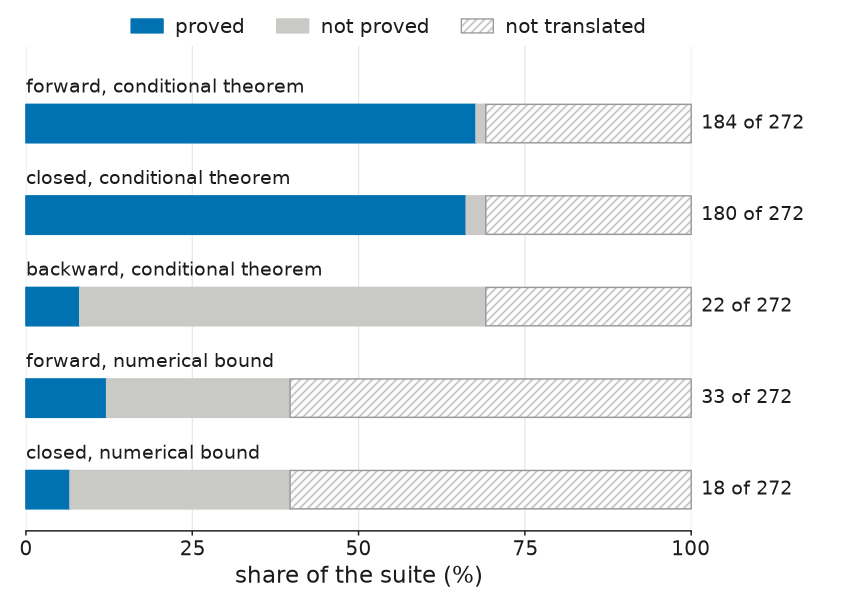
Figure 1. What FloatLib's roundoff tactic proves on FPBench. A bar is one kind of theorem over the whole suite, split into the cases proved, not proved and not translated to Lean, with the number proved at its end: 272 cases, the 136 programs of twelve FPBench suite files in binary32 and in binary64. Run on 2026-11-20 with Lean 4.36.0 on an Intel Xeon Platinum 8275CL (96 threads, shared with other jobs); these are the suite runs recorded in the repository of FloatLib.
| theorem | proved | not proved | not translated | cases |
|---|---|---|---|---|
| forward, conditional theorem | 184 | 4 | 84 | 272 |
| closed, conditional theorem | 180 | 8 | 84 | 272 |
| backward, conditional theorem | 22 | 166 | 84 | 272 |
| forward, numerical bound | 33 | 75 | 164 | 272 |
| closed, numerical bound | 18 | 90 | 164 | 272 |
There are 272 cases: the 136 programs of the twelve FPBench suite files, in binary32 and in binary64.
- A conditional theorem keeps its premises (for example, that no operation overflows).
roundoffproves 184 forward, 180 closed-form and 22 backward ones. Forward, closed and backward are its three methods. - A numerical bound is a second Lean proof that discharges those premises on the program's input box and proves one proposed number. That is the kind of result FPTaylor or Gappa print, and here it is proved for 33 cases forward and 18 closed, 51 in all. This is the weak spot today: most cases that get a conditional theorem don't get their number yet.
- Not translated (84 cases) means that the translator refuses the program: loops, tensors and operators it has no translation for. It refuses instead of truncating a loop or changing a program.
- Backward analysis is proved for 22 cases only.
roundoffgives a backward theorem when the program has a backward-error form on its inputs, and it refuses the rest with the reason.
A count says what the tactic did on this suite, not what it does on all programs.
What was run
| FloatLib | main at fc2fad1f, Lean 4.36.0 |
| FPBench | https://github.com/FPBench/FPBench at 8ac4ff6cf0c3be4f9669a562ef2bbbbc3b15182d, MIT: all 12 benchmarks/*.fpcore suite files |
| Limits | 60 seconds and 4 GB per Lean process, for a conditional theorem and for a numerical bound |
| Date and machine | 2026-11-20T11:24:20Z to 2026-11-20T11:32:47Z, an Intel Xeon Platinum 8275CL (2 sockets, 96 hardware threads, 1.1 TB), Amazon Linux 2023, shared with other jobs |
Method. This is FloatLib's own suite run, the one recorded in its repository under
benchmarks/results/suites/. Its driver fetches FPBench at the pinned commit with checksums, translates each
FPCore program (benchmarks/fpbench/translate.py), and elaborates each proof in a fresh Lean environment that also
checks the transitive axioms: a case counts only with propext, Classical.choice and Quot.sound. The suite was
not run again for this week. The library sources of the recorded run differ from the commit fc2fad1f by one added
corollary and the version number, and no tactic differs.
From Lean: every proof and its axioms. From scripts: the translation and the counts.
Files
results/counts.csvandresults/run.csv.figures/: the figure as PNG and SVG, with its caption and notes.scripts/:collect.py(reads the counts from a FloatLib checkout) andplot.py.
Run it again
The harness is FloatLib's. In a FloatLib checkout at fc2fad1f:
bash benchmarks/suites/run.sh selftest
FLOATLIB_SUITE_RESULTS=$PWD/suite-results bash benchmarks/suites/run.sh fpbench
python3 benchmarks/suites/summarize.py $PWD/suite-results
and then, here, FLOATLIB_DIR=/path/to/FloatLib python3 fpbench/scripts/collect.py fpbench and
python3 fpbench/scripts/plot.py.