One operation inside the proof checker: Lean's kernel with FloatLib, Coq with Flocq
float_decide proves a closed floating-point statement by running the arithmetic in Lean's kernel. So what does
one operation cost there? This suite times FloatLib's kernel path against
Flocq 4.2.2 in Coq 8.20.1, under vm_compute and under lazy, on the same
operands, from 32 to 4,096 bits.
Result
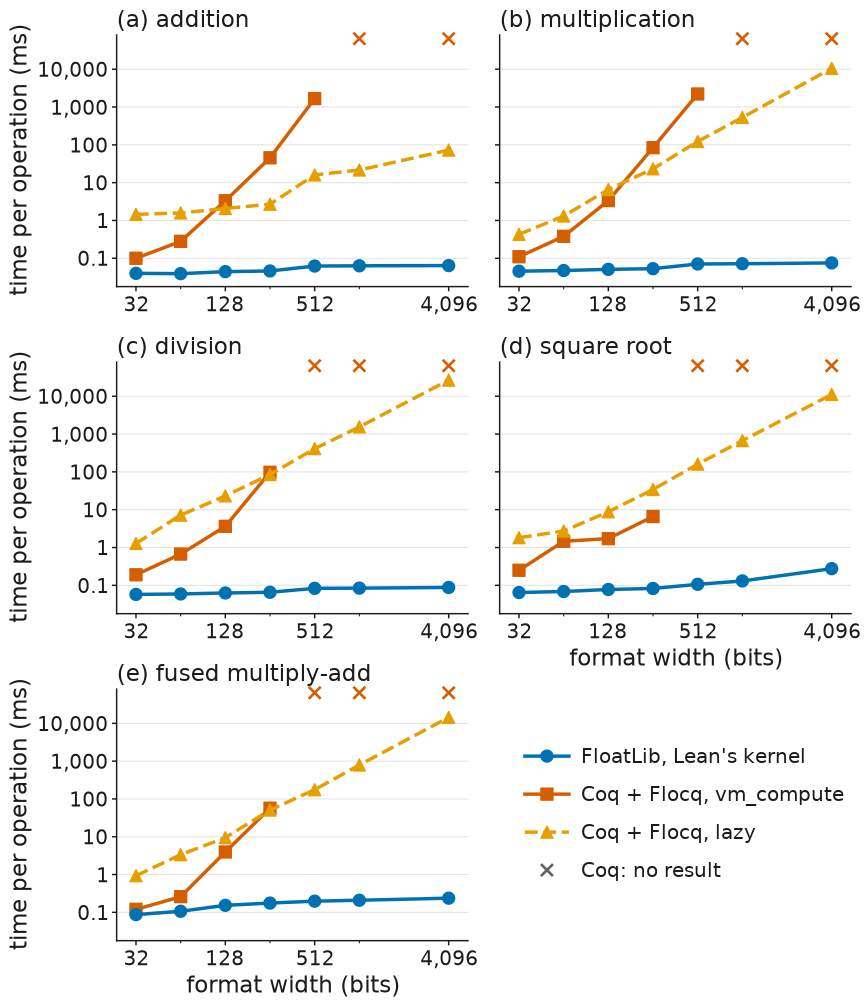
Figure 1. Time of one floating-point operation inside the proof checker: FloatLib in Lean's kernel against Flocq 4.2.2 in Coq 8.20.1 under vm_compute and under lazy, from 32 to 4,096 bits. A point is the time per operation, in milliseconds, in a loop of 100 operations (10 from 512 bits on) on the same operands; a cross at the top marks a width where Coq gave no result within 8 GB and 300 seconds. Both axes are logarithmic, and lower is faster. The Lean times are the median of 5 runs of FloatLib on 2026-11-20 with Lean 4.36.0 on an Intel Xeon Platinum 8275CL (96 threads, shared with other jobs); the Coq times are the recorded run of 2026-11-15 on the same machine, in a container with 8 GB and two CPUs, and do not depend on FloatLib.
| operation | width (bits) | FloatLib in Lean's kernel (µs) | Coq + Flocq, vm_compute (ms) |
Coq + Flocq, lazy (ms) |
|---|---|---|---|---|
| add | 32 | 39.9 | 0.10 | 1.45 |
| mul | 32 | 45.5 | 0.11 | 0.43 |
| div | 32 | 57.5 | 0.19 | 1.28 |
| sqrt | 32 | 64.5 | 0.25 | 1.82 |
| fma | 32 | 87.2 | 0.12 | 0.93 |
| add | 64 | 39.2 | 0.28 | 1.58 |
| mul | 64 | 47.3 | 0.38 | 1.31 |
| div | 64 | 59.0 | 0.67 | 7.18 |
| sqrt | 64 | 68.5 | 1.46 | 2.73 |
| fma | 64 | 106.9 | 0.26 | 3.36 |
| add | 128 | 44.3 | 3.31 | 2.07 |
| mul | 128 | 50.9 | 3.35 | 6.58 |
| div | 128 | 62.7 | 3.63 | 23.20 |
| sqrt | 128 | 77.6 | 1.72 | 8.80 |
| fma | 128 | 153.5 | 3.95 | 9.46 |
| add | 256 | 46.1 | 45.38 | 2.69 |
| mul | 256 | 53.0 | 84.32 | 23.25 |
| div | 256 | 65.4 | 97.71 | 85.21 |
| sqrt | 256 | 82.4 | 6.60 | 34.22 |
| fma | 256 | 176.1 | 56.80 | 50.77 |
| add | 512 | 62.3 | 1,673.80 | 16.00 |
| mul | 512 | 70.7 | 2,213.40 | 122.70 |
| div | 512 | 83.2 | no result | 410.50 |
| sqrt | 512 | 106.3 | no result | 160.00 |
| fma | 512 | 197.6 | no result | 175.40 |
| add | 1,024 | 63.2 | no result | 21.60 |
| mul | 1,024 | 71.7 | no result | 531.00 |
| div | 1,024 | 84.2 | no result | 1,550.10 |
| sqrt | 1,024 | 130.4 | no result | 671.90 |
| fma | 1,024 | 209.2 | no result | 788.90 |
| add | 4,096 | 64.0 | no result | 72.60 |
| mul | 4,096 | 75.3 | no result | 10,535.20 |
| div | 4,096 | 87.7 | no result | 26,733.50 |
| sqrt | 4,096 | 276.0 | no result | 11,169.20 |
| fma | 4,096 | 237.3 | no result | 14,328.80 |
- Lean's kernel takes 39 to 276 µs per operation over all widths and operations, and the time barely moves with the width.
- Where Coq gave a result,
vm_computetakes 1.4 to 31,329 times Lean's time (median 24, 22 cells) andlazy9 to 304,898 times (median 342, 35 cells). At binary32 the two checkers are close: 100 µs against 40 µs for an addition undervm_compute. - Coq gave no result in 13 of the 70 cells within 8 GB and 300 seconds, all of them
vm_computefrom 512 bits on. - In the recorded run Coq printed the value that Lean computed in every row.
Flocq is a general formalization that people use to prove things about floating point, and it was not written
to be run at 4,096 bits inside vm_compute. FloatLib's kernel layer was written for exactly that. So read this as
what each library costs when you use it for proof by computation, not as a ranking of the two.
What was run
| FloatLib | main at fc2fad1f, Lean 4.36.0 |
| Coq and Flocq | Coq 8.20.1 with Flocq 4.2.2: Bplus, Bmult, Bdiv, Bsqrt and Bfma of BinarySingleNaN with mode_NE |
| Date and machine | Lean: 2026-11-20, 5 runs between 20:50Z and 21:18Z on an Intel Xeon Platinum 8275CL (2 sockets, 96 hardware threads, 1.1 TB), Amazon Linux 2023, shared with other jobs, 43 to 66 percent idle. Coq: the recorded run of 2026-11-15 on the same machine, in a container with 8 GB and two CPUs. The Coq times do not depend on FloatLib |
Method. Both sides run FloatLib's own matched loops (benchmarks/suite/matched.py in its repository): a loop of
100 operations (10 from 512 bits on) on the same operands, and the time per operation is the loop's time divided by
its length. On the Lean side the timed term is the one that float_decide checks (#kernel_cost rewritten,
measured with Lean.Kernel.whnf), run through FloatLib's timing mode with a core-scheduling cookie. A cell of that
runner is one sample, so I ran it five times and the table has the median per cell. Over the 35 Lean cells the five
runs differ by 5.8 percent of the median in the median cell and 13 percent at the 90th percentile. One cell is an
outlier: binary32 addition took 75.5 µs in the first run, while the load of the machine was rising, and 39.1 to
40.3 µs in the other four.
What failed, and what was not run. Coq was not run again for this week: every Coq cell gets 300 seconds, and
13 cells of the recorded run had no result within that and 8 GB. The Coq numbers are the recorded ones
(benchmarks/results/figures/recorded/coq-flocq.csv in FloatLib's repository).
From Lean: the Lean times. From scripts: the Coq times (printed by Coq in a container), the medians and the ratios.
Files
results/kernel-coq.csv: per operation and width, Lean's median with the fastest and the slowest run, and Coq's two times.results/run.csv: the facts of the five runs.figures/: the figure as PNG and SVG, with its caption and notes.scripts/:run_kernel_sections.py,collect.py,plot.py.
Run it again
export FLOATLIB_DIR=/path/to/FloatLib            # at fc2fad1f, built, with its benchmark workspace
for n in 1 2 3 4 5; do python3 kernel-vs-coq/scripts/run_kernel_sections.py kernel-vs-coq/work/timing$n; done
python3 kernel-vs-coq/scripts/collect.py kernel-vs-coq/work/timing{1,2,3,4,5}
python3 kernel-vs-coq/scripts/plot.py
The Coq side is benchmarks/suite/run.sh matched in FloatLib's repository, which needs a container with Coq
8.20.1 and Flocq 4.2.2.