LeanCert's benchmarks with interval
LeanCert is a Lean library for certified numerics: interval evaluation,
Taylor models, root finding, integration, and tactics on top of them. It is the closest thing to FloatLib's
interval tactic in Lean, so I wanted to see the two side by side on LeanCert's own material: its seven benchmark
suites, its two script benchmarks, and the statements its examples and tests prove.
Three things to keep in mind, stated here once. The bounds of the suite goals are the enclosures LeanCert's own evaluators report, so those goals sit exactly at LeanCert's edge by construction. LeanCert ran on a port to Lean v4.36.0 that I made (three edits and one added file, all its tactic tests green), not on the toolchain it is released for. And the machine was shared and at times saturated: both tools were timed side by side, but single times carry that noise, and the time of one goal can be off by a factor of two between runs.
Result
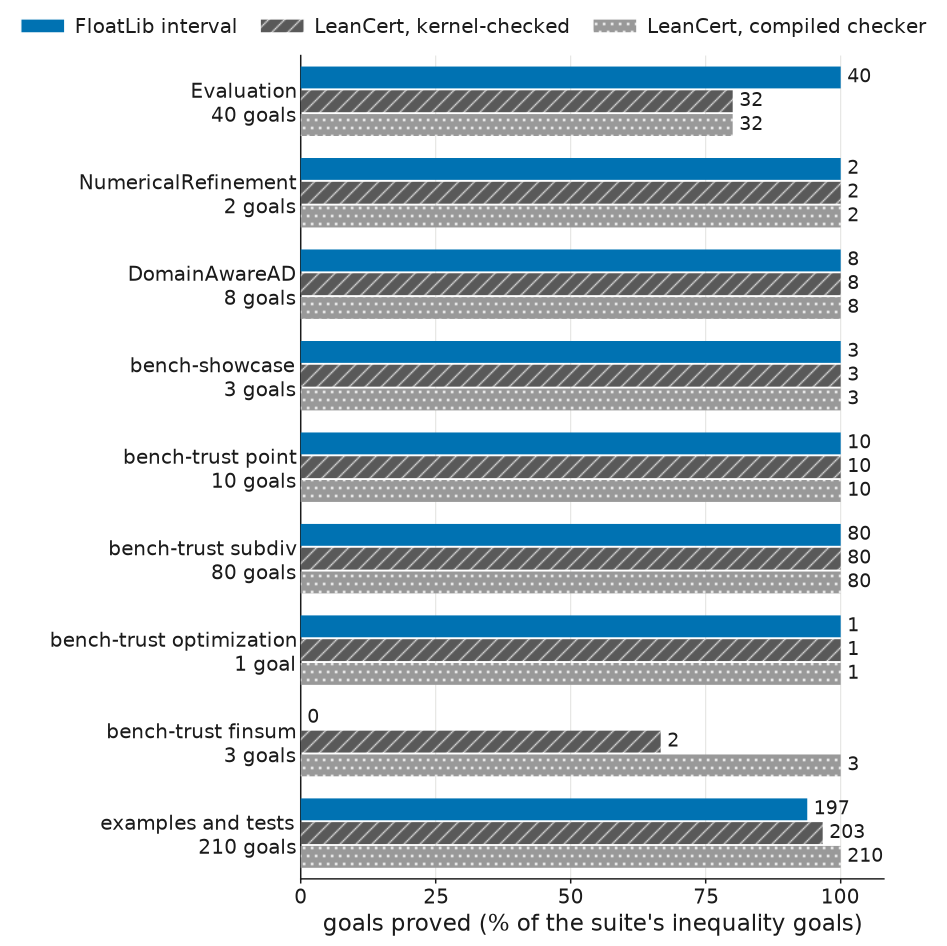
Figure 2. Share of each suite's inequality goals that FloatLib's interval and LeanCert's own tactic prove with one call; the number at the end of a bar is the count of goals. The first eight rows are LeanCert's benchmark suites and script benchmarks, stated as goals; the last row holds the inequalities, with six combinations of comparisons, that LeanCert's examples and tests prove with one tactic call. Goals of other shapes (integrals, root existence and uniqueness, exact identities, list constructions, derivatives) are not in the figure, because interval does not address them. Measured on FloatLib and LeanCert 44b323a ported to Lean 4.36.0 and Mathlib v4.36.0, on 2026-11-21 on an Intel Xeon Platinum 8275CL (96 threads, shared with other jobs).
LeanCert's seven suites have 119 cases. They time compiled evaluators and checkers, and none of the cases is a
theorem statement, so each case was first stated as a goal (112 goals). Every goal was given to LeanCert's own
tactic and to interval, one call each, with the same lean binary on the same machine.
- Inequality goals of the seven suites (50 goals).
intervalproves all 50: 35 in a plain file, 14 after raising Lean's recursion and heartbeat limits, 1 with a larger precision. LeanCert, kernel-checked, proves 42, and the same 42 with its compiled checker. - Time per goal on the 42 goals both prove: median 254 ms for
intervaland 4.9 s for kernel-checked LeanCert, a median ratio of 8.6.intervalis the faster one on 38 of them and LeanCert on 4. Against LeanCert's compiled checker the median ratio is 4.7. - LeanCert proves what
intervaldoes not address (62 goals of the seven suites). Bounds on definite integrals, existence and uniqueness of roots, derivatives, exact polynomial identities and list constructions.intervalproves real inequalities and refutes sets of real comparisons. It does not integrate, isolate roots or differentiate. LeanCert proves 30 of these kernel-checked (37 with its compiled checker), and they are not counted for or againstinterval. - LeanCert's two script benchmarks (99 statements, 97 of them inequalities).
intervalproves 94 and kernel-checked LeanCert 96. The difference is three finite sums:intervalproves none of them (100, 1,000 and 10,000 terms), and LeanCert'sfinsum_boundproves the first two kernel-checked and all three with its compiled checker. - LeanCert's examples and tests (210 inequalities or combinations of comparisons).
intervalproves 197 and kernel-checked LeanCert 203. Whatintervalmisses there: finite sums of 100 terms and more, real powersx ^ (1/2)on a box that touches zero, the Euler-Mascheroni constant, and a conjunction of two quantified bounds. - All together (357 goals in
interval's scope):intervalproves 341 and kernel-checked LeanCert 341. 327 are proved by both, 14 only byinterval, 14 only by LeanCert and 2 by neither. On the common goals the median time per goal is 66 ms forintervaland 638 ms for LeanCert (median ratio 8.7), andintervalis the faster one on 303 of them.
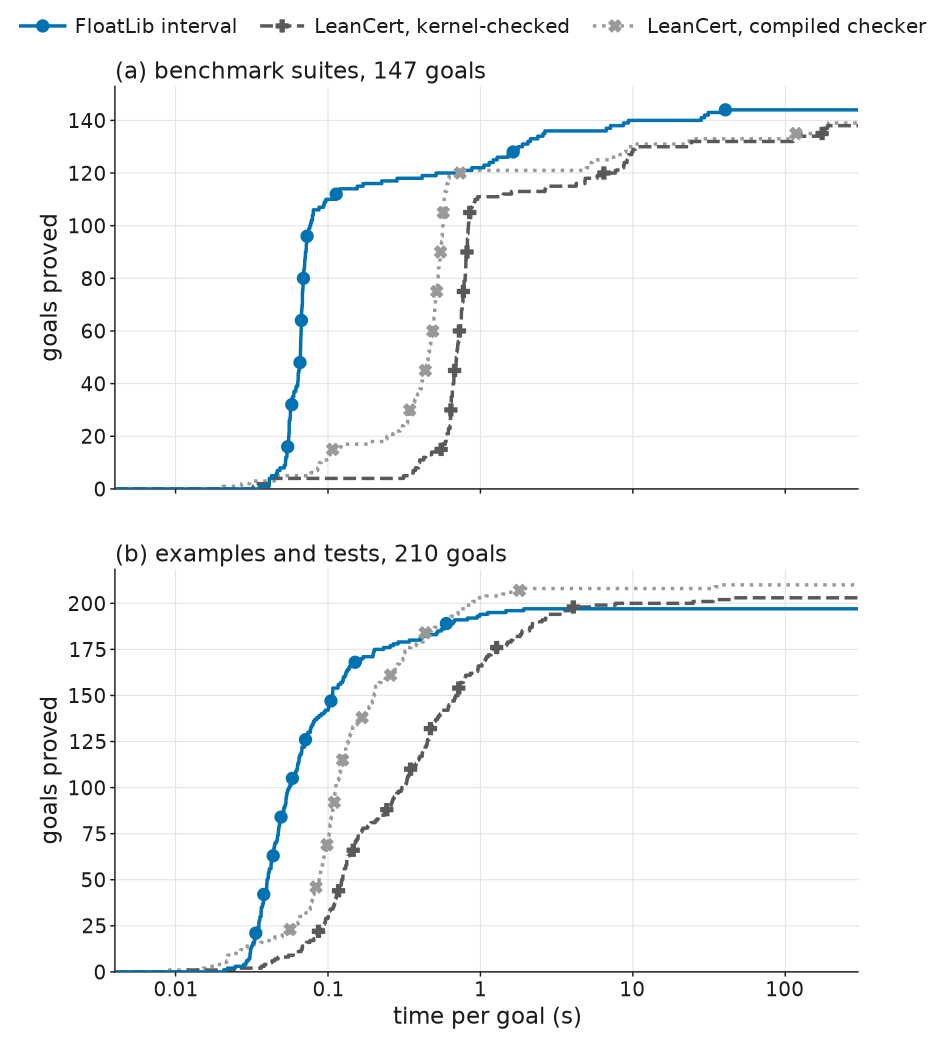
Figure 1. Goals proved against time per goal, by FloatLib's interval and by LeanCert's own tactic on the same statements, each with one call. A curve counts the goals proved within the time on the horizontal axis; the time is that of the whole theorem command inside Lean (elaboration, the tactic and the kernel check), the median of two repetitions for a run under 20 s and one repetition otherwise, with both tools running side by side. Panel (a) holds the inequality goals of LeanCert's seven benchmark suites and of its two script benchmarks, panel (b) the inequalities, with six combinations of comparisons, that LeanCert's examples and tests prove with one tactic call. The time axis is logarithmic, a curve further left is faster and one that ends higher proves more. Measured on FloatLib and LeanCert 44b323a ported to Lean 4.36.0 and Mathlib v4.36.0, on 2026-11-21 on an Intel Xeon Platinum 8275CL (96 threads, shared with other jobs), at most 7 Lean processes at once.
In the tables, n (a, b, c) means n goals proved: a in a plain file with default options, b only with raised
Lean limits, c only with the larger tactic options. Times are per goal, medians over the goals both tools prove.
The ratio is LeanCert's time divided by interval's, per goal, then the median.
Table 1. The seven suites: inequality goals
| Suite | Cases | Goals | Inequality goals | interval |
LeanCert, kernel-checked | LeanCert, compiled checker | Both | Median time interval |
Median time LeanCert | Median ratio |
|---|---|---|---|---|---|---|---|---|---|---|
| Evaluation | 69 | 40 | 40 | 40 (26, 14, 0) | 32 (14, 18, 0) | 32 (20, 12, 0) | 32 | 349 ms | 6.3 s | 8.4 |
| Integration | 12 | 26 | 0 | |||||||
| Krawczyk | 6 | 6 | 0 | |||||||
| DomainAwareAD | 6 | 17 | 8 | 8 (8, 0, 0) | 8 (8, 0, 0) | 8 (8, 0, 0) | 8 | 553 ms | 3.1 s | 8.3 |
| AlgebraicBezout | 3 | 3 | 0 | |||||||
| DyadicSubdivision | 18 | 18 | 0 | |||||||
| NumericalRefinement | 5 | 2 | 2 | 2 (1, 0, 1) | 2 (2, 0, 0) | 2 (2, 0, 0) | 2 | 38 ms | 1.2 s | 29.4 |
| all | 119 | 112 | 50 | 50 (35, 14, 1) | 42 (24, 18, 0) | 42 (30, 12, 0) | 42 | 254 ms | 4.9 s | 8.6 |
Table 2. The seven suites: goals outside interval
| Suite | Goals outside interval |
Shape | LeanCert, kernel-checked | LeanCert, compiled checker | What interval says |
|---|---|---|---|---|---|
| Integration | 14 | integral | 0 | 0 | an atom has no bound (14) |
| Integration | 12 | checker flag | 5 | 12 | not stated: LeanCert's own vocabulary (12) |
| Krawczyk | 6 | root | 4 | 4 | not stated: LeanCert's own vocabulary (4); not an inequality (2) |
| DomainAwareAD | 9 | derivative | 0 | 0 | an atom has no bound (9) |
| AlgebraicBezout | 3 | identity | 3 | 3 | not stated: LeanCert's own vocabulary (3) |
| DyadicSubdivision | 18 | list construction | 18 | 18 | not stated: LeanCert's own vocabulary (18) |
Table 3. LeanCert's script benchmarks
| Suite | Cases | Goals | Inequality goals | interval |
LeanCert, kernel-checked | LeanCert, compiled checker | Both | Median time interval |
Median time LeanCert | Median ratio |
|---|---|---|---|---|---|---|---|---|---|---|
| bench-showcase | 5 | 5 | 3 | 3 (3, 0, 0) | 3 (3, 0, 0) | 3 (3, 0, 0) | 3 | 57 ms | 638 ms | 8.3 |
| bench-trust point | 10 | 10 | 10 | 10 (10, 0, 0) | 10 (10, 0, 0) | 10 (10, 0, 0) | 10 | 61 ms | 596 ms | 9.8 |
| bench-trust subdiv | 80 | 80 | 80 | 80 (80, 0, 0) | 80 (80, 0, 0) | 80 (80, 0, 0) | 80 | 66 ms | 749 ms | 11.6 |
| bench-trust optimization | 1 | 1 | 1 | 1 (1, 0, 0) | 1 (1, 0, 0) | 1 (1, 0, 0) | 1 | 56 ms | 313 ms | 5.6 |
| bench-trust finsum | 3 | 3 | 3 | 0 (0, 0, 0) | 2 (1, 1, 0) | 3 (3, 0, 0) | 0 | |||
| all | 99 | 99 | 97 | 94 (94, 0, 0) | 96 (95, 1, 0) | 97 (97, 0, 0) | 94 | 66 ms | 728 ms | 11.4 |
Table 4. Statements of LeanCert's examples and tests, by shape
| Shape | Statements | interval |
LeanCert, kernel-checked | LeanCert as written |
|---|---|---|---|---|
| inequality | 204 | 192 (191, 0, 1) | 197 (194, 3, 0) | 204 (202, 2, 0) |
| existence | 49 | 5 (5, 0, 0) | 49 (49, 0, 0) | 49 (49, 0, 0) |
| inequality in ℕ with a ceiling | 21 | 0 (0, 0, 0) | 21 (21, 0, 0) | 21 (21, 0, 0) |
| integral | 10 | 0 (0, 0, 0) | 10 (10, 0, 0) | 10 (10, 0, 0) |
| conjunction | 4 | 3 (3, 0, 0) | 4 (4, 0, 0) | 4 (4, 0, 0) |
| bound for all large n | 2 | 0 (0, 0, 0) | 2 (2, 0, 0) | 2 (2, 0, 0) |
| disequality | 2 | 2 (2, 0, 0) | 2 (2, 0, 0) | 2 (2, 0, 0) |
Goals one proves and the other does not
intervaland not kernel-checked LeanCert (14). Four goals whose bound is the enclosure of LeanCert's own rational evaluator for nested sines on[-1/16, 1/16], the 640-map affine chain (two goals) and the 2,048-term cancellation (two goals), where LeanCert runs out of the 300 s. And six statements that LeanCert's tests prove withinterval_bound_adaptive, a tactic that has no kernel-checked route.- Kernel-checked LeanCert and not
interval(14). Finite sums (∑ k ∈ Finset.Icc 1 100, (k : ℝ) ≤ 5050takes LeanCert'sfinsum_bound0.4 s, andintervaldoes not finish it in 300 s), three bounds on the Euler-Mascheroni constant, for whichintervalhas no enclosure, four real powers on a box that touches zero (∀ x ∈ Set.Icc 0 4, x ^ (1/2) ≤ 2), and one conjunction of two quantified bounds. - Neither (2). Finite sums of 5,000 and 10,000 terms. LeanCert's compiled checker proves both in 0.2 s.
How a case became a goal, and how a goal was run
The rules were fixed before any tactic ran, and they are the same for every case
(scripts/gen_goals.py).
- A case that computes an enclosure
[lo, hi]of an expression over a box becomes two goals,∀ x ∈ Set.Icc a b, e ≤ hiand∀ x ∈ Set.Icc a b, lo ≤ e, withloandhithe exact rationals the case reports (up to 55,000 digits for the rational backend). The Lean term mirrors the benchmark's syntax tree node for node. - A goal whose shape is not a real inequality is recorded as outside
interval. - The two script benchmarks already consist of statements, and they were taken verbatim.
scripts/harvest_examples.pytook every statement that LeanCert's examples and tests prove with one LeanCert tactic call, if the statement names nothing of LeanCert.
One Lean process per goal, tool and configuration (scripts/run_goals.py):
- One call. FloatLib:
interval. LeanCert:leancert, its front door, or the dedicated tactic that LeanCert's own benchmark or test names (interval_decide,finsum_bound,certify_bound, ...). - Axioms. A goal counts only if Lean reports no error and
#print axiomslists nothing beyondpropext,Classical.choiceandQuot.sound. LeanCert ships withleancert.trust = "native": its certificates are closed bynative_decide, which adds one axiom per proof. So LeanCert was run twice: with(trust := kernel), which is the column that counts, and as shipped, reported for reference. - A ladder. A plain file and the default options first. Only if that fails, the same call with
maxRecDepth 100000andmaxHeartbeats 0("raised limits"). Only if that fails, one fixed set of larger options, the same for every goal. Nothing was tuned to a goal. Every run has 300 s of wall time. - Time per goal is the time of the
theoremcommand inside Lean: elaboration of the statement, the tactic and the kernel check of the proof, without the import. ImportingLeanCert.Tacticalone takes a process 3.1 s here and importingFloatLib3.2 s. The proving rung of both tools was run again side by side, and the time per goal is the median of these timing runs.
The port of LeanCert
LeanCert pins Lean v4.35.0 and Mathlib v4.35.0. To run both tools with the same lean binary I ported it to Lean
v4.36.0 and Mathlib v4.36.0 (scripts/leancert-lean-4.36.diff): two one-line
source edits, one new file with its import, and the version pins. The new file is the one that matters for a fair comparison.
Mathlib v4.36.0 defines real arithmetic as private definitions that a package outside the module system can unfold,
and LeanCert's metaprograms were written against opaque arithmetic. The file marks ten definitions irreducible
again, so LeanCert behaves as written, and all of its tactic tests build on the port. Three analysis modules that
nothing here needs were not ported, and the compiled benchmark executable was not built: LeanCert's harness was run
with the interpreter, only to read off the enclosure each case computes.
What was run
| FloatLib | main at fc2fad1f |
| LeanCert | https://github.com/alerad/leancert at 44b323a0d6af00211d5013f6e021432db032087c (2026-10-28, Apache-2.0), ported as above |
| Lean and Mathlib | leanprover/lean4:v4.36.0, the same lean binary for both tools, and Mathlib v4.36.0 |
| Date and machine | 2026-11-21, an Intel Xeon Platinum 8275CL (2 sockets, 96 hardware threads, 1.1 TB), Amazon Linux 2023, shared with other jobs. Idle CPU between 0 % and 62 % (median 38 %) during the runs, at most seven Lean processes at once |
What failed and why. interval, inequality goals not proved: no proof in 300 s (7), an atom has no bound (4), a
partial function rejected the box (4), not an inequality (1). LeanCert kernel-checked, inequality goals not proved:
no proof in 300 s (6), proved only with a compiler axiom (6), no LeanCert strategy proved it (2), maximum recursion
depth (2).
Not measured here: LeanCert's compiled harness timings, and LeanCert on its own toolchain. LeanCert publishes
wall times for its bench-trust files on an Apple M1 Max with Lean v4.32.2: about 0.1 s per interval_decide
lemma on the kernel route.
From Lean: every verdict and every time per goal (IO.monoNanosNow around the theorem command). LeanCert's
enclosures, which are the bounds of the goals, come from LeanCert's own harness. From scripts: the goal
statements, the process wall times and the timeouts, the medians, counts and ratios, and the figures.
Files
results/goals.csv: one row per goal with both tools' verdict, rung and time.results/suites.csv,results/cases.csv(per harness case),results/digest.json(the totals quoted above),results/examples-dropped.csv(statements left out, with the reason).figures/: both figures as PNG and SVG, with captions and notes.scripts/:fetch.shandleancert-lean-4.36.diff(LeanCert at its commit, ported),lcbuild.sh,lcrun.sh,flrun.sh,harness_cases.sh,gen_goals.py,harvest_examples.py,run_goals.py,summarize.py,plot.py.
Run it again
lake build                                                  # in the week's directory: FloatLib
bash leancert/scripts/fetch.sh                              # LeanCert at its commit, ported to Lean v4.36.0
bash leancert/scripts/lcbuild.sh LeanCert.Tactic LeanCert.Benchmark.Main
python3 leancert/scripts/run_goals.py --help                # goals, runs and repetitions
python3 leancert/scripts/summarize.py && python3 leancert/scripts/plot.py