VNN-COMP 2025: exact binary32 replay of the published counterexamples
When a neural-network verifier answers "sat" at the International Verification of Neural Networks Competition, it publishes a counterexample: an input point, in decimals, and the outputs it computed there. That is a concrete floating-point claim, and a concrete claim can be checked exactly. Here FloatLib evaluates each network in IEEE binary32 at each published point, in four orders of summation and in exact arithmetic, and decides the property on exact rationals.
This is exact checking of counterexamples. No network is verified: an "unsat" result can be refuted here by a point, and it is never confirmed. The results are reported by benchmark family. The competition's own scoring is the place for per-tool numbers.
Result
Ten benchmark families were replayed: 5,737 counterexample files with 9,165 points.
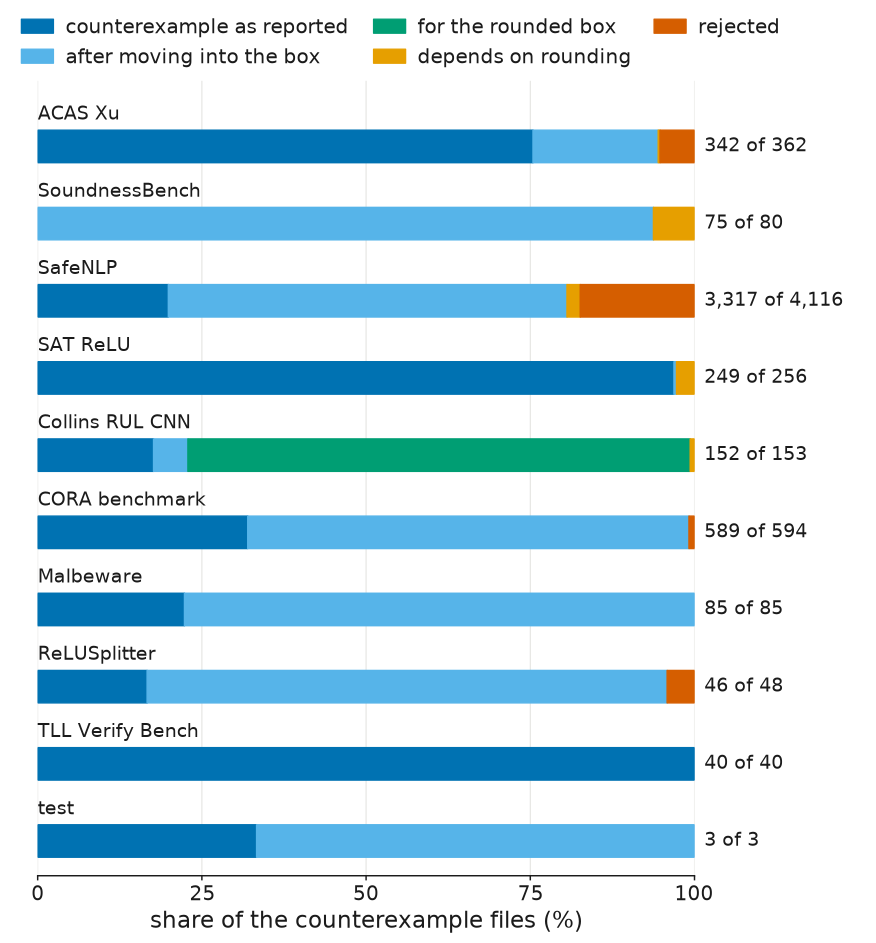
Figure 1. What exact evaluation says about the counterexamples that the verifiers of VNN-COMP 2025 published for ACAS Xu, SoundnessBench, SafeNLP, SAT ReLU, Collins RUL CNN, the CORA benchmark, Malbeware, ReLUSplitter, TLL Verify Bench and the test family. A bar is the counterexample files of one benchmark family, split into the files whose reported point is a counterexample, those whose point becomes one after each coordinate outside the input box is moved to the nearest binary32 number inside, those that are counterexamples only for the box with its bounds rounded to binary32, those whose verdict depends on rounding, and those rejected; the number at its end is the files confirmed in one of the first three ways. Each network was evaluated with FloatLib's compiled binary32 operations in four orders of summation and in exact arithmetic, and the property was decided on exact rationals. Evaluated on 2026-11-21 with FloatLib and Lean 4.36.0 on an Intel Xeon Platinum 8275CL (96 threads, shared with other jobs).
| family | instances | with a "sat" result | with an exact counterexample | for the rounded box only | files replayed | as reported | moved into the box | rounded box | depends on rounding | rejected |
|---|---|---|---|---|---|---|---|---|---|---|
| ACAS Xu | 186 | 47 | 47 | 0 | 362 | 273 | 69 | 0 | 1 | 19 |
| SoundnessBench | 50 | 50 | 50 | 0 | 80 | 0 | 75 | 0 | 5 | 0 |
| SafeNLP | 1,080 | 647 | 647 | 0 | 4,116 | 819 | 2,498 | 0 | 83 | 716 |
| SAT ReLU | 98 | 49 | 49 | 0 | 256 | 248 | 1 | 0 | 7 | 0 |
| Collins RUL CNN | 62 | 23 | 5 | 18 | 153 | 27 | 8 | 117 | 1 | 0 |
| CORA benchmark | 180 | 131 | 131 | 0 | 594 | 190 | 399 | 0 | 0 | 5 |
| Malbeware | 150 | 19 | 19 | 0 | 85 | 19 | 66 | 0 | 0 | 0 |
| ReLUSplitter | 220 | 20 | 20 | 0 | 48 | 8 | 38 | 0 | 0 | 2 |
| TLL Verify Bench | 32 | 17 | 5 | 0 | 40 | 40 | 0 | 0 | 0 | 0 |
| test | 5 | 1 | 1 | 0 | 3 | 1 | 2 | 0 | 0 | 0 |
| all ten | 2,063 | 1,004 | 974 | 18 | 5,737 | 1,625 | 3,156 | 117 | 97 | 742 |
- Most published counterexamples are real, but not at the point printed. 1,625 files are counterexamples as reported. 3,156 more become one only after the point is moved into the box: the printed point, read to binary32, lies outside the box, by at most 6.9e-7 in a coordinate and by 7e-9 in the median, and the nearest binary32 point inside violates the property. Verifiers print points on the faces of the box, and the binary32 number nearest to a decimal bound is often just outside it.
- 117 files (Collins RUL CNN) are counterexamples only for the box with rounded bounds. Their properties fix inputs to decimals that are not binary32 numbers, so the box holds no binary32 point at all.
- For 97 files the verdict depends on rounding: the four binary32 orders and exact arithmetic do not agree on whether the property is violated.
- 742 files are rejected: at the deciding point no order of summation and no exact evaluation violates the property. They are of two kinds. 474 print outputs that violate the property but that the network does not produce at the printed input. The other 268 are boundary points on SafeNLP: the printed point is outside the box by about 7e-9 with a margin of the property below 7e-7, and at the nearest point inside the box the exact output is on the safe side by 2e-8 to 1e-6.
- No "sat" result is wrong, only some witnesses. In every one of the 742 instances another file is an exact counterexample. Of the 1,004 instances with a "sat" result in these families, 974 have an exact counterexample and 18 one for the rounded box. The other 12 are TLL Verify Bench instances whose networks were too large to replay.
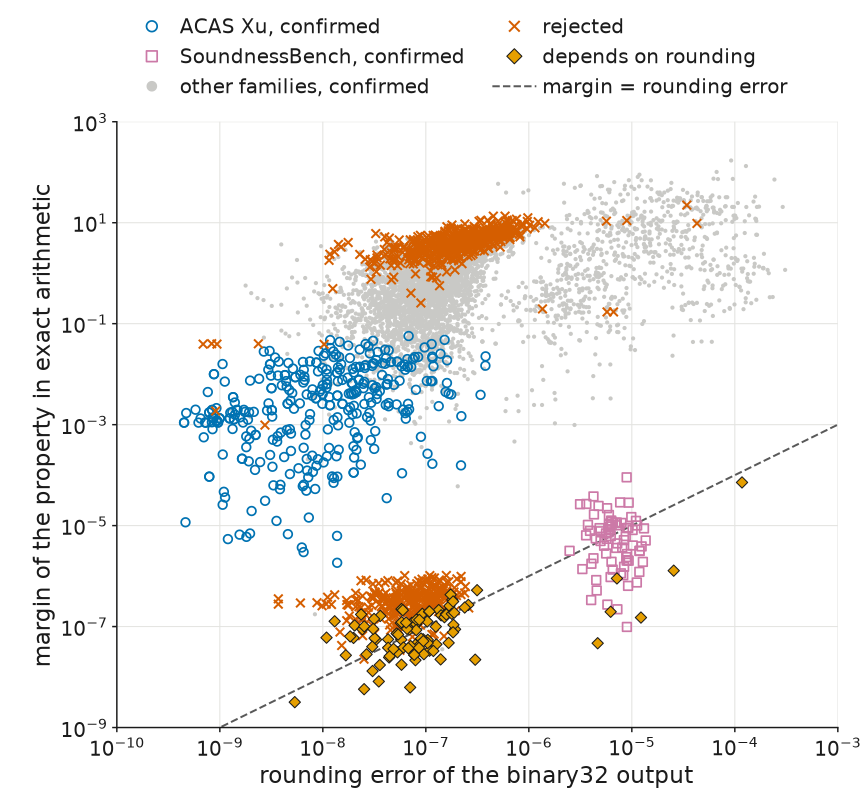
Figure 2. How decisive each published counterexample is: the margin by which the network's exact output violates, or fails to violate, the property, against the rounding error of the binary32 evaluation. A marker is one counterexample file; the margin is the absolute slack of the output property at the exact rational output, and the rounding error is the largest absolute difference between a binary32 output and that exact output, both in the units of the network's output. Both axes are logarithmic. Evaluated on 2026-11-21 with FloatLib and Lean 4.36.0 on an Intel Xeon Platinum 8275CL (96 threads, shared with other jobs).
Figure 2 shows why the borderline files are borderline: their margin is the size of the network's own rounding error.
"Unsat" results on instances that have an exact counterexample. 476 "unsat" results are on instances for which another file is a counterexample inside the box: a binary32 point at which the binary32 network, in each of the four orders, and the real-valued network all violate the property.
| family | "unsat" results | refuted by an exact counterexample | of which with a kernel-accepted witness | penalised by the competition, tolerance 1e-4 | penalised, tolerance 0 | given points, tolerance 0 | not scored by the competition |
|---|---|---|---|---|---|---|---|
| ACAS Xu | 1,010 | 1 | 1 | 1 | 1 | 0 | 0 |
| SoundnessBench | 30 | 30 | 0 | 30 | 0 | 30 | 0 |
| SafeNLP | 3,118 | 403 | 403 | 403 | 21 | 382 | 0 |
| SAT ReLU | 206 | 42 | 42 | 32 | 32 | 0 | 10 |
| all | 4,364 | 476 | 446 | 466 | 54 | 412 | 10 |
The competition scores the same results twice, with tolerance 1e-4 and with tolerance 0. Its own scoring with tolerance 1e-4 already penalises 466 of the 476. The other 10 are results of a tool that the competition did not score. With tolerance 0 it penalises 54 and gives 10 points each to the other 412: a counterexample that is only "correct up to tolerance" leaves the instance undecided, and an "unsat" on an undecided instance earns points too. Over the 486 instances that the zero-tolerance scoring leaves undecided, exact replay finds a counterexample in the box for 470 and one for the rounded box for the other 16. So exact replay decides what the two scorings disagree on.
On SoundnessBench all 50 instances have an exact counterexample, although every one of the 80 published points lies outside the box (by 3.5e-9 to 1.2e-7). Moved into the box, all 80 violate the property in exact arithmetic, 75 of them also in all four binary32 orders and 5 in some of them, by an exact margin of only 5e-8 to 9e-5, the size of the rounding error of the network itself.
In Lean's kernel. The verdicts above are computed by compiled Lean code. For the small networks they are also
theorems: Lean's kernel replayed all of ACAS Xu and SAT ReLU, one witness per instance of SafeNLP and of the test
family, and the boundary files on SafeNLP. That is 2,576 points and 18,414 theorems in 193 Lean files, every one
accepted, and every audited theorem rests on propext, Classical.choice and Quot.sound only.
| family | Lean files | points | points accepted | theorems | audited with #print axioms | files with exit 0 | errors | instances with a kernel counterexample | refuted unsat results with a kernel witness | sum of wall time (s) | time inside the kernel (s) | median file (s) | slowest file (s) | peak memory of a file (GB) |
|---|---|---|---|---|---|---|---|---|---|---|---|---|---|---|
| ACAS Xu | 42 | 563 | 563 | 6384 | 2128 | 42 | 0 | 47 of 47 | 1 of 1 | 9073 | 7909 | 163 | 563 | 6.2 |
| SafeNLP | 52 | 1755 | 1755 | 10530 | 7020 | 52 | 0 | 647 of 647 | 403 of 403 | 7784 | 6101 | 155 | 182 | 5.7 |
| SAT ReLU | 98 | 257 | 257 | 1488 | 992 | 98 | 0 | 49 of 49 | 42 of 42 | 4410 | 2154 | 31 | 182 | 9.1 |
| test | 1 | 1 | 1 | 12 | 4 | 1 | 0 | 1 of 1 | 0 of 0 | 31 | 15 | 31 | 31 | 4.9 |
744 of the 974 instances with an exact counterexample have one accepted by the kernel, and 446 of the 476 refuted "unsat" results have a kernel-accepted witness. The 30 on SoundnessBench do not: one multiply-add costs about 1.1 ms in the kernel in the form the generated files use, against about 0.15 microseconds compiled, and one evaluation of that model (24 million multiply-adds) would take the kernel about seven hours.
Cross-checks (none feeds a result). numpy float32, in the same order of operations, gives the same binary32
outputs as FloatLib's compiled Binary32 at all 9,165 points, and FloatLib's decimal parser agrees with exact
rational rounding on all 2.4 million input values. onnxruntime 1.32.0, the runtime of the competition's checker,
sums in another order and differs in the last bits at most points. Its verdict on the output differs from the
reference order's at 114 of 14,432 evaluations, all at points whose margin is below the rounding error. An exact
integer evaluation in Python agrees with the Lean replay on all 1,424 cases it checked.
What is checked
A counterexample file lists decimal values for the inputs and for the outputs. The replay
(scripts/Replay.lean, a compiled Lean program on FloatLib) does the following for every
point of every file.
- Input. Each decimal is rounded once to binary32, to nearest with ties to even, by FloatLib's
ExecFloat.Binary.parse, and checked against rounding the exact fraction (ExecFloat.Binary.ofRat). - Network. The ONNX graph, lowered to a chain of layers with every weight as its binary32 word, is evaluated
on FloatLib's
Binary32with its compiled*,+,-and<. The reference order accumulates every dot product from+0, left to right, with one rounded multiplication and one rounded addition per term, and adds the bias last. The same network is also evaluated in three other orders (right to left, pairwise, one fused multiply-add per term) and in exact arithmetic (dyadic numbers, no rounding at all). - Property. The VNNLIB property is decided on exact rationals.
- Moving into the box. A coordinate outside its interval is moved to the nearest binary32 number inside, and the network is evaluated again at the moved point. Where the interval of a coordinate holds no binary32 number at all, the coordinate is moved to its bounds rounded to nearest instead: the "rounded box".
- Verdict. ONNX fixes the element type of
MatMul,GemmandConvbut not the order of their additions, so "the binary32 output" is one number only up to that order. A file is confirmed only when the four orders and exact arithmetic all violate the property, rejected only when none does, and reported as depending on rounding otherwise.
The competition's checker works differently, and on purpose: it reads the decimals as binary64, tests the box on those values, runs onnxruntime on their binary32 rounding, compares with the outputs printed in the file and tests the property on the printed outputs, all with a tolerance. Exact replay and a tolerance answer different questions.
What was run
| FloatLib | main at fc2fad1f, Lean 4.36.0, Mathlib v4.36.0 |
| Benchmarks | https://github.com/VNN-COMP/vnncomp2025_benchmarks at 8b7b811b, 14 families fetched sparse (927 MB) |
| Published results | https://github.com/VNN-COMP/vnncomp2025_results at ea89fbc2 (81 MB): results.csv, the counterexample files of the 8 participating tools (alpha-beta-CROWN, CORA, NeuralSAT, nnenum, NNV, PyRAT, Rover, SobolBox) and the logs of the competition's two scorings |
| Python | 3.12.13 with numpy 2.5.0, onnx 1.22.0, onnxruntime 1.32.0 and matplotlib 3.11.0 |
| Date and machine | 2026-11-21, an Intel Xeon Platinum 8275CL (2 sockets, 96 hardware threads, 1.1 TB), Amazon Linux 2023, shared with other jobs. The load average was between 60 and 220 during the whole run |
Time. One binary32 evaluation with FloatLib's compiled operations takes a median of 2 ms on ACAS Xu (13,000 multiply-adds) and 3.4 s on the SoundnessBench model (24 million), about 0.15 microseconds per multiply-add in both. Exact arithmetic takes up to 7 times as long. The whole replay of the nine families other than SoundnessBench took 19 min 48 s with 5 processes, SoundnessBench alone 14 min 19 s, and the kernel files 5.9 hours of Lean summed over the files. These are wall-clock times on a loaded machine. They say what the check costs here, not how fast FloatLib is.
Limits
- No network is verified. An "unsat" that no published point refutes is neither confirmed nor refuted.
- Families. The competition's result repository covers 26 families. 14 with small files were fetched and 10 of them translate. Cersyve, Dist Shift, LinearizeNN and LSNC ReLU are not translated, because their ONNX graphs are not chains of layers, and 16 of the 32 TLL Verify Bench networks have 10 to 67 million weights and were left out by a size limit of 5 million. That leaves 273 counterexample files unreplayed. The other 12 families (CIFAR, ImageNet, YOLO, ViT and other large networks) were not fetched.
- Order of summation. Four orders are evaluated. onnxruntime's own order (vectorised and blocked) is not one of them.
- The translation is trusted. The ONNX reader, the VNNLIB reader and the counterexample reader are Python scripts without proofs. They are checked by agreement with numpy, onnxruntime and an exact integer evaluation. The kernel theorems are about the generated Lean definitions.
- SoundnessBench. What is replayed is the VNN-COMP 2025 family
soundnessbench(one model, 50 instances) with the counterexamples published in the competition. The hidden counterexamples of the separate SoundnessBench benchmark are not published, so there is nothing to replay there.
From Lean, compiled: every binary32 and exact evaluation, the rounding of the inputs, the moved points and every comparison behind a verdict. From Lean's kernel: the reference-order verdicts at the points of the kernel table. From Python scripts: the translation of ONNX, VNNLIB and counterexample files, the cross-checks, the reading of the competition's logs, the counts, the tables and the figures.
Files
results/families.csv: one row per family, the numbers of the tables above.results/margins.csv: one row per replayed file, its family, its verdict, the rounding error of the binary32 output and the margin of the property in exact arithmetic.figures/: both figures as PNG and SVG, with captions and notes.scripts/:fetch.sh, the replayReplay.lean(thereplayexecutable of the week's Lake project), the readerscommon.pyandprepare.py,pipeline.shandrun_chunks.sh, the cross-checkscrosscheck.py,ort_compare.py,spotcheck.pyandhandcheck.py,competition.py,analyze.py,family_summary.py, the kernel filesgen_kernel.py,witness_ids.py,run_kernel.shandkernel_table.py, andplot.py.
Run it again
lake build replay                                           # in the week's directory
bash vnncomp-replay/scripts/fetch.sh                        # the benchmarks and the published results, pinned
R=vnncomp-replay/run; P=vnncomp-replay/scripts
F="acasxu_2023 soundnessbench safenlp_2024 sat_relu collins_rul_cnn_2022 cora_2024 malbeware relusplitter tllverifybench_2023 test"
python3 -I $P/prepare.py $R/dl/vnncomp2025_benchmarks/benchmarks $R/dl/vnncomp2025_results $R/work $F
bash $P/pipeline.sh 5 $F                                    # replay, numpy and onnxruntime comparisons
python3 -I $P/competition.py $R/dl/vnncomp2025_results $R/results $F     # the competition's two scorings
python3 -I $P/analyze.py $R/work $R/results $F
python3 $P/family_summary.py $R/results
python3 $P/plot.py
The kernel files are written by gen_kernel.py and checked with lake env bash vnncomp-replay/scripts/run_kernel.sh.